English words can be tricky, especially when two words sound almost the same. One common grammar question is: should you write lead or led? Many people get confused because both words are linked to guiding, directing, or being in charge. The confusion becomes even bigger because “lead” can be both a verb and a noun, while “led” is only a verb form.
People often search for “lead or led” when writing emails, school papers, blog posts, resumes, or business documents. They want to know which spelling is correct and when to use it. A small mistake can change the meaning of a sentence and make writing look unprofessional.
The good news is that the rule is simple once you understand it This article gives quick answers and detailed explanations in easy language.
Lead or Led – Quick Answer
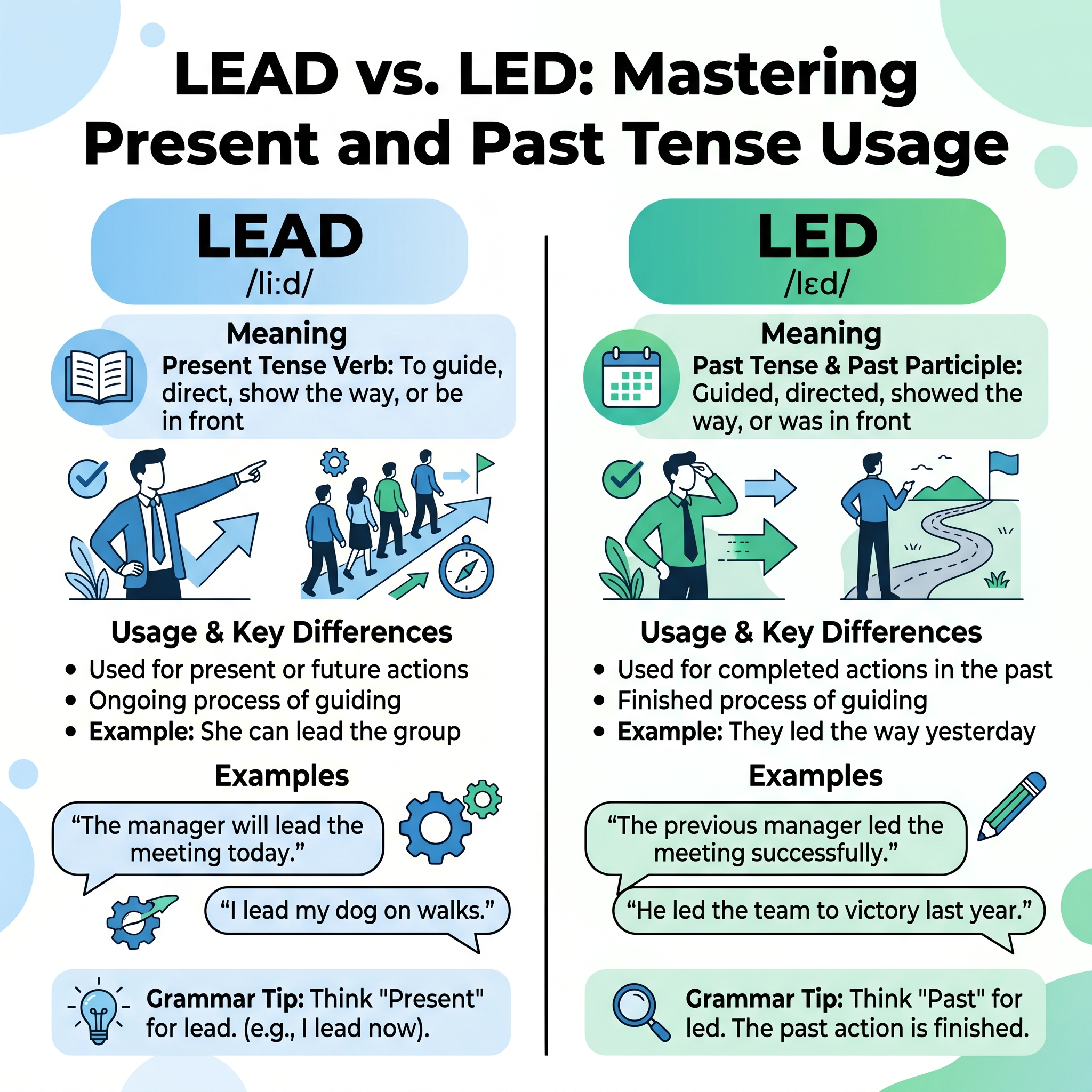
The difference between lead and led is about time.
- Lead is the present tense.
- Led is the past tense.
Correct Examples
- She will lead the team tomorrow.
- He led the group last year.
- Good teachers lead students well.
- Our captain led us to victory.
Simple Rule
Use:
- Lead for present or future actions.
- Led for past actions.
| Word | Meaning | Tense |
| Lead | To guide or direct | Present/Future |
| Led | Guided or directed | Past |
The Origin of Lead or Led
The word lead comes from Old English. It originally meant “to guide” or “show the way.” Over time, English grammar changed, and the past tense became led.
The confusion happens because English also has another word spelled lead, which is a metal. That word is pronounced differently.
Two Meanings of “Lead”
| Word | Meaning | Pronunciation |
| Lead | To guide | LEED |
| Lead | A metal | LED |
This pronunciation difference causes many spelling mistakes.
The word led developed as the proper past tense form of the verb “lead.”
British English vs American English Spelling
Both British English and American English use the same spellings:
- lead
- led
There is no spelling difference between the two English styles.
Comparison Table
| English Style | Present Tense | Past Tense |
| British English | Lead | Led |
| American English | Lead | Led |
Example Sentences
- UK: She will lead the meeting.
- US: He led the project successfully.
Both countries follow the same grammar rules.
Which Spelling Should You Use?
The correct choice depends on the sentence tense.
Use “Lead” When:
- Talking about the present
- Talking about the future
- Giving instructions
Use “Led” When:
- Talking about the past
- Describing completed actions
Audience-Based Advice
| Audience | Best Choice |
| US Audience | Lead/Led |
| UK Audience | Lead/Led |
| Global Audience | Lead/Led |
Always match the word to the correct tense.
Common Mistakes with Lead or Led
Many writers mix these words because they sound similar.
Mistake 1: Using “Lead” for Past Tense
She lead the team yesterday.
She led the team yesterday.
Mistake 2: Confusing the Metal with the Verb
The coach used lead strategies.
The coach used leading strategies.
Mistake 3: Wrong Verb Tense
He will led the group tomorrow.
He will lead the group tomorrow.
Easy Memory Tip
- Today I lead
- Yesterday I led
Lead or Led in Everyday Examples
In Emails
- Sarah will lead tomorrow’s meeting.
- John led the discussion last week.
In News Reports
- The captain led the team to victory.
- Experts lead talks on climate change.
On Social Media
- She led an amazing campaign online.
- Great leaders lead with kindness.
In Formal Writing
- The manager will lead the new project.
- The scientist led the research study.
Lead or Led – Google Trends & Usage Data
Search data shows that many people search for “lead or led” because of grammar confusion.
Popular Search Reasons
- School assignments
- Resume writing
- Business communication
- Grammar correction
- English learning
Usage by Context
| Word | Common Usage | Popularity |
| Lead | Present/Future tense | Very High |
| Led | Past tense | Very High |
English learners often confuse these words because “lead” and “led” sound alike in some situations.
Comparison Table: Lead vs Led
| Feature | Lead | Led |
| Verb Form | Present/Future | Past |
| Meaning | Guide or direct | Guided or directed |
| Used in Formal Writing | Yes | Yes |
| Common Grammar Mistake | Often confused with led | Often replaced with lead |
| Used in British English | Yes | Yes |
| Used in American English | Yes | Yes |
FAQs:
Is “led” the past tense of “lead”?
Yes. “Led” is the correct past tense form of “lead.”
Why do people confuse lead and led?
The words look similar, and “lead” also refers to a metal pronounced like “led.”
Is “leaded” correct?
Usually no. Standard English uses “led” as the past tense.
Do British and American English use different spellings?
No. Both use “lead” and “led.”
Which word should I use in a resume?
Use “led” for past achievements and “lead” for current responsibilities.
Can “lead” be a noun?
Yes. “Lead” can mean a main role, clue, or position.
Is “led” ever used as a noun?
No. “Led” is mainly used as a verb.
Conclusion:
The difference between lead or led becomes simple once you understand verb tense. Use lead when talking about the present or future. Use led when talking about the past.
Many people make mistakes because the word “lead” has two meanings. One is a verb meaning “to guide,” and the other is a metal pronounced like “led.” This can confuse writers, especially English learners.
Still, the grammar rule is clear:
- Today you lead
- Yesterday you led
Both British English and American English follow the same spelling rules. That means you can confidently use these words in emails, school work, social media, blogs, and professional writing.
Choosing the correct form helps your writing look polished, accurate, and professional. A small spelling change can improve clarity and make your message easier to understand.

Ethan Lexford is a language researcher and grammar content writer at Gramlytic. He specializes in explaining confusing English words, spelling differences, grammar rules, and vocabulary comparisons in a simple and easy-to-understand way for learners, writers, and students worldwide.